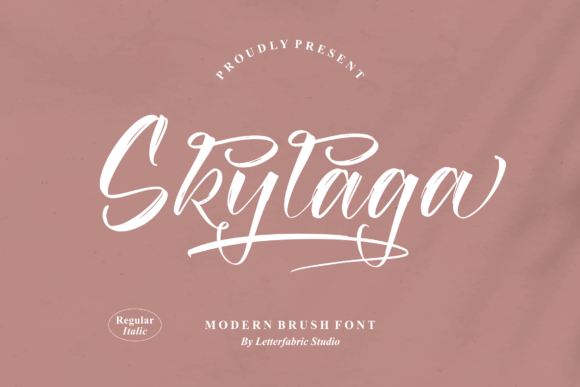
Skylaga: A Delicate Script Font for Branding
It started with a blank brand board and a client who wanted something soft, elegant, and a little bit whimsical. They were launching a small skincare line, and the vision was to create a brand that felt personal, trustworthy, and approachable. I knew I needed a font that could carry that mood without being too bold or too plain. That’s when I discovered Skylaga.
Skylaga for Logo Design and Brand Identity
As a script handwritten font, Skylaga has this gentle flow that feels like it was written by hand, but with enough consistency to work in a professional setting. I tested it on a logo draft, and immediately, it brought a sense of warmth to the design. The curves are smooth, the spacing is just right, and it carries a modern yet timeless feel. It wasn’t too flashy, but it had character—exactly what the client was looking for.
When working on brand identity, the font needs to be versatile. Skylaga proved to be adaptable across different elements—website headers, social media posts, even product labels. Its PUA encoding meant I could access all the glyphs and alternates without any issues, which was a relief when designing custom text for packaging.
Skylaga for Packaging Design and Product Labels
One of the first things I did was mock up a label for a serum bottle. Skylaga looked great on a small scale, maintaining its elegance even at smaller sizes. It worked well as a headline font, drawing attention without overwhelming the other elements. I paired it with a clean sans serif for the ingredient list, which helped balance the design and keep the focus on the product name.
The font also held up on printed materials like business cards and brochures. It gave the brand a cohesive look, and the handwritten touch added a personal, artisanal feel that aligned with the client’s values. It wasn’t too ornate, so it didn’t clash with more minimal design elements.
Skylaga for Social Media Graphics and Web Headers
When it came to digital assets, Skylaga shone in web headers and social media graphics. I used it for a hero section on the client’s website, where it stood out against a neutral background. It added a soft contrast that made the message pop without being distracting. On Instagram, it worked well for post captions and branded content, giving the feed a unified aesthetic.
I also experimented with it in a series of promotional banners. The font’s flowing style complemented the visual elements, creating a sense of movement and fluidity that matched the brand’s messaging. It wasn’t overpowering, but it had enough personality to make an impression.
Skylaga for Creative Products and Merchandise
The client eventually wanted to expand into merchandise, like t-shirts and stickers. Skylaga worked beautifully on these items. On a t-shirt, it added a subtle yet stylish touch, especially when used in a short phrase or a single word. It was readable enough for casual wear but still felt special and unique.
For stickers, the font’s delicate lines translated well, even when printed on small surfaces. I made sure to test it at different sizes and angles to ensure it remained legible. It performed consistently, which was important for a product that would be seen up close.
Skylaga for Editorial Design and Print Materials
Even in editorial design, Skylaga found its place. I used it for a blog header and a newsletter title, where it added a refined, professional edge. It wasn’t too busy, so it didn’t interfere with the readability of the body text. When paired with a serif font, it created a nice contrast that elevated the overall design.
For print materials like flyers and posters, the font maintained its clarity and charm. It was perfect for headings and subheadings, helping to guide the viewer through the content while keeping the visual hierarchy clear.
Skylaga for Brand Consistency and Professionalism
One of the most important aspects of branding is consistency. Skylaga helped maintain that across all touchpoints. Whether it was a website, a product label, or a social media post, the font remained recognizable and consistent. This helped build a stronger brand identity and made the client’s message more memorable.
It also contributed to a sense of professionalism. Even though it’s a script font, it didn’t feel too informal. Instead, it struck a balance between creativity and structure, which is exactly what the client needed for their brand.
Skylaga for Font Pairing and Design Flexibility
When pairing fonts, I often look for contrast and harmony. Skylaga worked well with both serif and sans serif fonts, depending on the context. For a more traditional look, I paired it with a classic serif, while for a modern twist, I used a clean sans serif. In both cases, the combination felt natural and balanced.
Its versatility allowed me to experiment with different styles and layouts. Whether I was designing a logo, a brochure, or a social media graphic, Skylaga provided a solid foundation that could be adapted to fit various design needs.
Skylaga for Commercial Use and Licensing
One thing I always check when using a new font is the licensing. Skylaga is PUA encoded, which means it’s easy to use in commercial projects without worrying about extra licensing fees. This was a big plus for the client, as they wanted to use the font across multiple platforms and materials.
The font also included a range of styles and alternates, which gave me more creative freedom. I could choose different versions of letters to add variation and prevent repetition in the design. It was a practical feature that made the font even more useful in a real-world project.